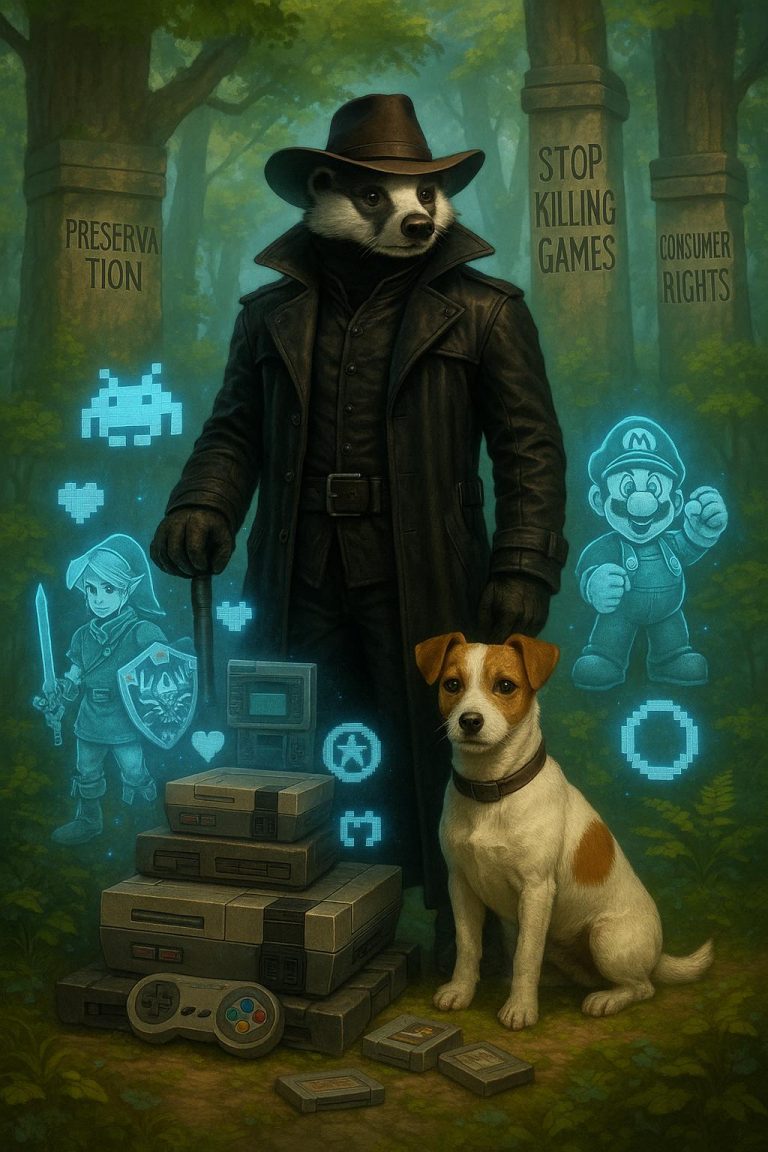
Lord Badger and his Sidekick Scamp embark on a crusade to Stop Killing Games and fight for consumer rights
Part One: What Are Delisted Games?
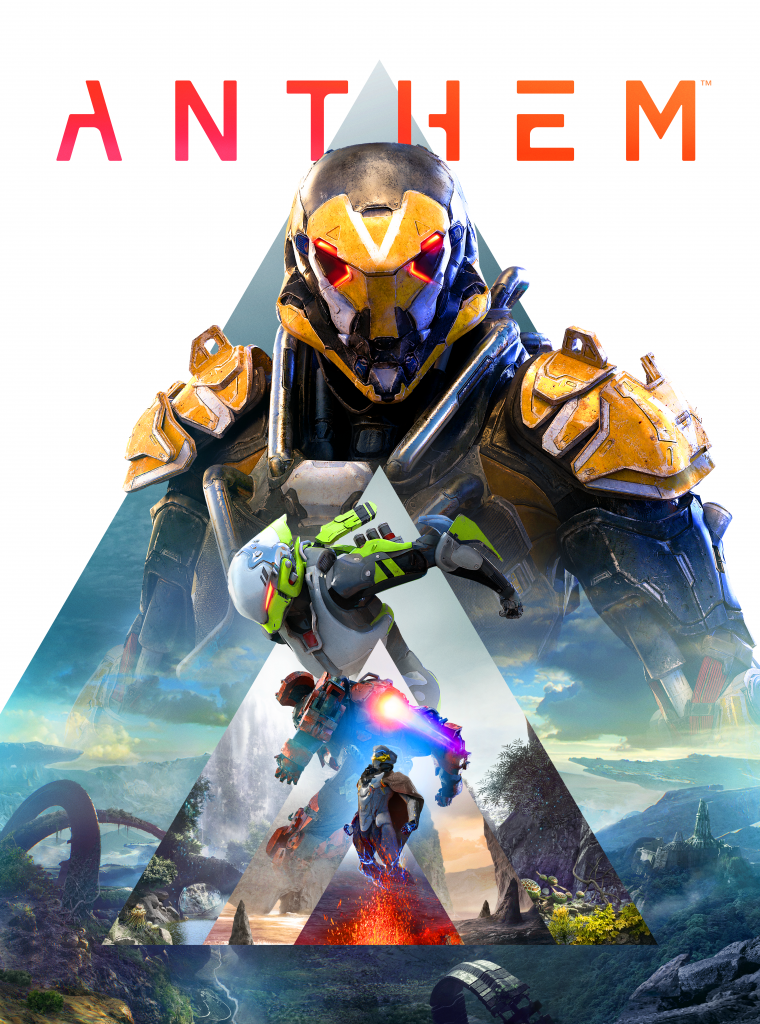
Exactly one week ago today Anthem – The multiplayer online action RPG that launched to much hype on 22 February 2019 – permanently closed down its online servers. Why is this news? And why has it triggered the first of what I intend to be a long running series of articles delving into a deep, complex and at times controversial topic? Quite simply….consumer rights.
Gamers have been steadily getting shafted more and more for years now and over the coming weeks and months I will attempt to explain all aspects of this issue but first, let’s get back to Anthem.
Released under much hype in February 2019, Anthem was developed by Bioware, The creators of Mass Effect and Dragon Age. An impressive pedigree of games meant gamers were extremely excited for the next brand new Bioware IP. Published by EA games, one of the biggest publishers in gaming history, and surely this was a recipe for success?
Unfortunately not, Anthem released to poor reviews and heavy criticism which ultimately meant the game was a flop. This resulted in the online servers for Anthem being shut down on the 12th January 2026.
This means just 2,516 days since its launch, Anthem is now completely unplayable. It cannot be downloaded from the digital store and it cannot be played…at all! If you have the disc version of the game it will only go so far as the title screen and then fail to connect to servers.
Compare this to say the Spectrum 48K, which was released in the UK on April 23rd 1982. Every single game ever released on that system is completely 100% playable today (as long as you can find a working copy of course).
The main difference between the Spectrum 48k and a PlayStation 5 is that spectrum games were only available on a physical cassette. Whereas PS5 games are predominantly bought digitally nowadays. And the brings us to our first issue….delisting
What is game delisting?
The term delisting refers to the digital version of a game being removed from an online market place so it can no longer be bought. This often, but not always, means if you have purchased the game you can download it and play it. However, if you didn’t buy the game before it was delisted then there is no way for you to buy or download the game digitally…ever!
There is no way of knowing just how many games have been delisted from modern marketplaces like the PlayStation Store but we can look at modern sales practices to determine and see a disturbing pattern.
Let’s take the highly popular FIFA series. First launched for the Sega Megadrive back in December 1993. It had a colossal impact on gaming and even to this day the series is still going strong (albeit it is now called FC26 as EA and Fifa went their separate ways)
EA Games is well known for its yearly updates to its lucrative sporting franchises such as FIFA, Madden and NBA series. In fact it is a running joke in the UK to wait for the latest edition of FIFA to be released and you can pick up the last one for around £1 in second hand game shops. But what if you wanted to buy it digitally and download the game? Well, you can’t because they have been delisted.
EA has released a total of 5 FIFA games on the PS5 (FIFA 22, FIFA 23, EA Sports FC 24, EA Sports FC 25 and EA SPorts FC 26) at the time of writing this article only two of those 5 games are available to buy online (EA Sports FC 25 and 26). Now I know what you are thinking. Was the problem. So i cant buy FIFA 23 on the online store anymore but I can pick it up for 50p in my local second games store. This is true. The point I am making here is about the sales tactics employed. When EA inevitably releases EA SPorts FC 27 at the end of this year they will delist EA FC 25 at the same time. Arguably one of the most culturally impactful game series of all time, once a year, has an old edition scrubbed from the online store.
This sales tactic of delisting games in order to force players to buy a new version of a game they have already purchased is not new. Thanks to the work of the wonderful guys over at Rocket Sloth I discovered this week that Minecraft has been delisted a whopping 11 times! Different versions of the game have been delisted in order to force players to buy the same game (and sometimes an inferior version) if they want to continue playing it!
Licensing issues
Another common reason for delisting, although not often admitted to, is licensing. As technology has progressed at lightning speed so does the capability of games. Gone are the days of 8 bit chiptune soundtracks. Now we have full audio recordings of popular real world bands and singers. The first example of this that always pops into my mind is The Offspring featuring on Crazy Taxi.
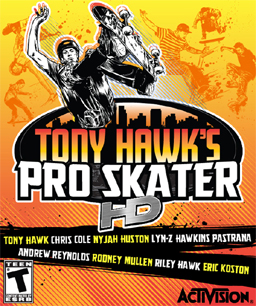
Tony Hawks’ series of skating games was well known for its amazing soundtrack that added a level of immersion and culture to the games. Unfortunately a vast majority of the titles in the series have been delisted as the music license, and in some cases, the image likeness agreements have expired. Having this type of licensing deal means the game is created, developed and released with an expiry date in mind and renewing the licences is often complex and costly so publishers like Activision simply delist the games.
Ownership and Consumer Rights
I have rambled on about delisting games and the many ways and reasons this occurs. But there is an ever growing online community of gamers that feel UK Law and Consumer Rights are simply not fit for purpose in this modern world.
I mentioned earlier that EA FC 24 is no longer able to be purchased from the online store. But if you have the physical copy you can still play the game. So no problem right? Well what if the game in question is made by Ubisoft?
You see, before you can play any Ubisoft game you must accept the terms and conditions of Ubisoft’s End User Licence Agreement (UELA). This is a legal declaration that you accept the terms of use.
In reality people just press the “I accept button” and continue without ever reading the reams and reams of small print but tucked away deep down in the UELA is this little gem:
Upon termination for any reason, you must immediately uninstall the Product and destroy all copies of the Product in your possession” — this applies to digital and physical copies.
Yep, you read that right. If Ubisoft decided to delist a game that you bought with your hard earned cash, then the UELA is terminated and you MUST destroy your physical copy. How can Ubisoft demand such a thing I hear you cry? Quite simply it comes down to the legal wording used in the games industry as standard right now. And the disconnect between gamers and publishers.
Gamers believe, and quite rightly in my opinion, that when you purchase a game (either physically or digitally) you have bought that game and own it. Just as would when you buy a coat or a pair of trainers for example.
What actually takes place, according to the publishers, is you purchase a licence to play the game and not actually the game itself. This is why almost every game released today has a licence agreement you have to accept before you can even begin to play the game. You don’t own the game, you merely acquired a licence.
Since you only have a licence to play the game the publisher can stop support for the game and terminate the licence at any time. This led to the counter protest saying of “If purchase isn’t ownership, then piracy isn’t theft”
The most famous of this reaction being the Stop Killing Games campaign. Which I will cover in depth in future.
I will also look into what can be done to save and preserve these delisted games. Take Anthem for example, One of the developers recently revealed there is code in the game that would allow for private servers and therefore keep the game alive. Could this be an option for online only games going forward?
Conclusion
I briefly touched up delisting games, music licensing and user licence in this introduction to the issue facing gamers. Hopefully you are a little bit more informed of the core issues with the games industry at the moment.
In future articles I am going to go more in depth in the issues with Consumer rights in the UK, The reaction of parliament (and hopefully get a response from some prominent MPs who have discussed the issue in Whitehall) game preservation and the cultural impact of this industry that saw an eye watering £7.6 BILLION! Pounds spent on it in 2024 alone.
Honestly, I have no idea where this series is going to go. How many articles it will consist of or when it will end (if ever) But as a games journalist, a lifelong gamer and a champion of fairness and honesty I invite you to join me on this journey as we jump down this ever growing complex rabbit hole.
Maybe we can force some change, maybe we can achieve something spectacular….or we may just go mad with the things we discover. I can promise you one thing however, We are going to hear some wonderful stories, meet some great people and possibly, just possibly, have a little fun along the way
About the Author