From Obsession to Family: SandKnight and the Community That Kept Azure Dreams Alive
When I had the idea to investigate the possibility of an Azure Dreams remake I was shocked to find that 27 years after its release there is an active online community. When I started digging into the modern Azure Dreams community, one name appeared almost immediately.
SandKnight.
He was described to me as one of the people behind the modern community surrounding the game, particularly through speedrunning, tournaments and the Discord server that would eventually become known as the Koh-mmunity. That made him an obvious person to speak to. I am happy to say Sandknight was extremely generous with his time and spent two hours answering my questions.
What I didn’t expect was how closely his story would intersect with the wider community that has kept Azure Dreams active over the last decade.
His own relationship with the Azure Dreams began, appropriately enough, completely by accident. His story has striking similarities to my own accidental discovery of Azure Dreams that I mentioned in this series first article
SandKnight bought a second-hand PlayStation from a friend because he wanted to play Final Fantasy VII. He was already a huge Final Fantasy fan and had been eagerly waiting to play the latest entry.
There was, however, a catch.The seller refused to part with the console and Final Fantasy VII alone. SandKnight had to buy the rest of his games too. He wasn’t particularly interested in them, but the bundle was still cheaper than buying a PlayStation new.
He got back to his house full of excitement and hooked up the PlayStation only to find the Final Fantasy VII disc wasn’t in the case.
His friend lived too far away to simply pop back that evening, so SandKnight started going through the unwanted games he had been forced to purchase as part of the deal.
Sports games.
Racing games.
Nothing particularly interesting.
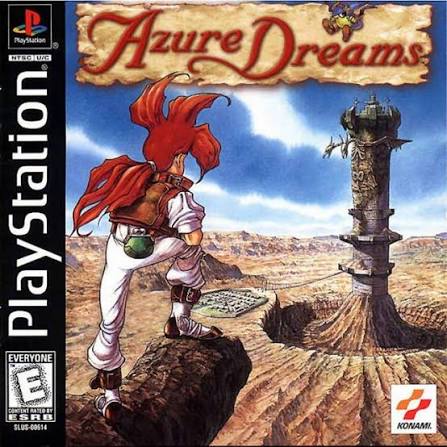
Then he spotted one with what he describes as a “weird anime redhead guy” on the cover.
He put Azure Dreams into the console and that was that. “I was completely hooked,” he told me.
He collected Final Fantasy VII the following day but it didn’t touch the PlayStation’s disc tray for another two months. A game he had never intended to own, Azure Dreams had taken over.
The Journey From Player to Speedrunner
Years later, SandKnight found himself drawn to the emerging speedrunning scene. This was before Twitch had become synonymous with the hobby. He had been an early follower of speedrunning and eventually decided that watching other people tear games apart wasn’t enough. He wanted to try it himself.
The obvious question was: which game? His thoughts eventually returned to Azure Dreams but there was only a problem. “How do you even speedrun that?” he remembers thinking.
His first completion of the game had taken around 30 hours. Even if he became three times faster, he reasoned, he could still be looking at a ten-hour run.
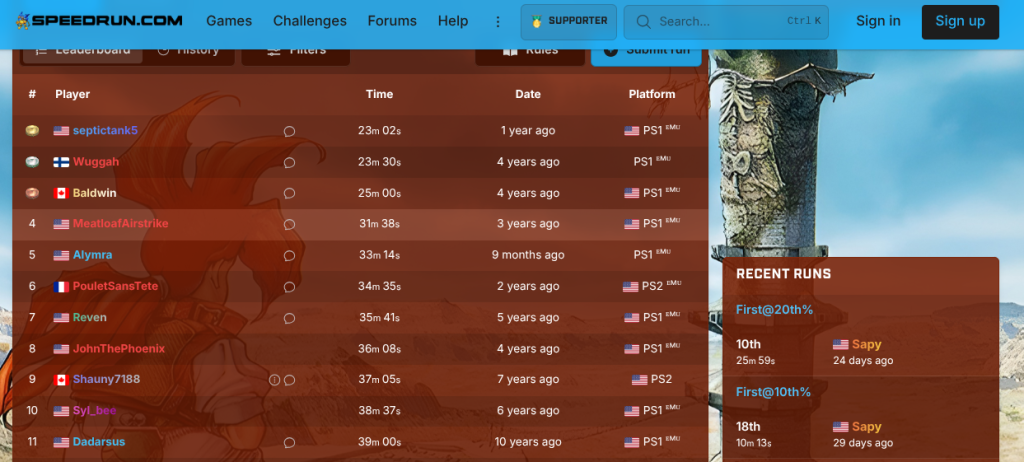
So he started searching. Has anybody else been mad enough to try it? It wasn’t long before two names emerged: CaptainLuigi and Adarsus. Both had recorded races to the tenth floor of the tower, while Adarsus had also posted a full Any% time (Any% is speedrunning terminology for completing a game as quickly as possible without requiring every objective, item or piece of optional content to be completed).
Forty-five minutes! SandKnight was stunned! There was just one problem, no video existed. So he tracked Adarsus down and asked if he would stream a run so he could see how it was possible and Adarsus agreed.
What SandKnight saw surprised him almost as much as the time itself. There was no spectacular game-breaking skip. No huge exploit. “He was just that good,” SandKnight said. Adarsus simply understood the mechanics deeply enough to stretch every resource almost to breaking point.
That was enough for SandKnight. He created a Discord server. Two other people joined early, and for a while there were only four members, talking almost exclusively about speedrun strategies. That tiny group would eventually grow into something much larger.
The Koh-mmunity
The Discord did not remain a four-person strategy room for long. Speedrunning became its foundation, while tournaments became one of the main drivers for growth. SandKnight organised tournaments lasting around three months, three times per year. Matches were restreamed through SpeedGaming’s Twitch channel, with six matches per week involving players across multiple time zones.
It worked. People found the game. People found the community. The server grew. But the workload was enormous. “It was brutal,” SandKnight told me. Eventually he had to scale back.
Others attempted to take on tournament organisation, but nobody maintained the same schedule after trying it themselves. As the tournaments became smaller and less frequent, activity naturally cooled from its peak. SandKnight does not speak about that period with regret. “The years where it was at its biggest are still some of the best times of my life,” he said. And importantly, the community never disappeared. New people still arrive regularly.
There remains a core of familiar names who are consistently active, and newcomers can still expect someone to answer their questions and welcome them in. I can attest to that! In just a few moments of posting my first message in the Discord server I had a couple of people provide informative answers and a list of names that lead to this interview.
SandKnight describes the Discord as quieter than it once was. But it is far from dead or inactive. It is simply settled.
Why Azure Dreams?
One of the central questions behind this series is why Azure Dreams has lasted at all. Thousands of games were released during the PlayStation era. Many sold better. Many belonged to much larger franchises. Yet people are still playing Azure Dreams almost thirty years later.
SandKnight believes part of the answer lies in how unusual the game’s design remains. He sees Azure Dreams as closely tied to the Mystery Dungeon tradition, particularly Shiren the Wanderer, itself descended from the harsher design philosophy of early Western roguelikes.
But he argues that relatively small changes made an enormous difference. Classic roguelikes could be brutally unforgiving. Death often meant starting again or losing almost everything. Azure Dreams could be equally cruel. But your familiar retained its experience.
That single concession meant each failed attempt could still leave the player slightly better prepared for the next one. Death hurt. But it also taught you something.
Then there was the loot. SandKnight points out that a surprisingly large percentage of items found during a run can feel genuinely useful or exciting, and that luck can theoretically hand you an exceptional weapon almost immediately.
“You can get the best weapon on floor one if luck is on your side,” he said. “That kept me wanting to do one more run.”
That phrase — one more run — perhaps explains Azure Dreams better than anything else.
Not Ahead of Its Time — Just Very Good?
Interestingly, SandKnight disagrees somewhat with one of my own developing theories about Azure Dreams. I have increasingly wondered whether Azure Dreams was ahead of its time? It combines roguelike progression, monster raising and town development in a way that feels remarkably compatible with genres that are now hugely popular.
SandKnight is less convinced. “I wouldn’t say so,” he told me. In his view, Azure Dreams owes too much to existing Mystery Dungeon design to be described as truly ahead of its time. But there is one area he will happily fight for…The menus.
Azure Dreams contains numerous button shortcuts allowing players to perform actions without digging through layers of menus. Want to issue a command to your familiar? There is a shortcut. Want to bag your familiar? Another shortcut. More importantly, SandKnight points to the responsiveness of the interface itself. Although menu animations play visually, the player is not forced to wait for them to finish before navigating. A sufficiently experienced player can perform inputs so quickly that menus effectively never appear on screen at all. In his words: “Every game needs this.” It is a wonderfully specific example of the kind of thing only somebody who has played a game thousands of times is likely to appreciate.
The Familiar Difference
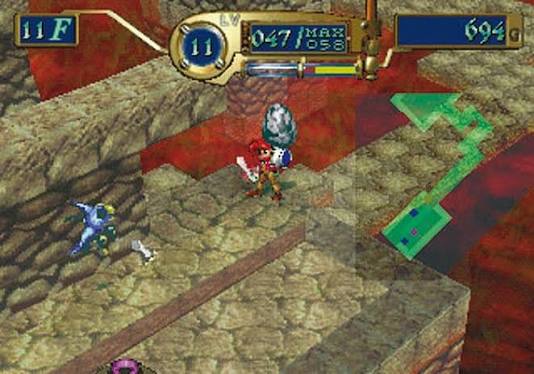
For new players, however, SandKnight believes the familiars remain the biggest hook. Companion systems existed before Azure Dreams, and many games have attempted them since. His argument is that Azure Dreams found an unusually effective balance between artificial intelligence and direct player control.
Familiars were capable of acting independently, but the player could still issue specific commands. That prevented them from simply charging into danger and dying at the first opportunity.
Then there were the eggs. Finding one inside the tower meant the possibility of bringing home something completely new. SandKnight puts it more colourfully, “Every Azure Dreams player still gets feel-good chemicals when they see the egg sprite on screen.”
I know exactly what he means.
Enter pro_grammar
The community’s technical development took a dramatic step forward during SandKnight’s second tournament. Before one match, he was explaining the rules to viewers on stream. One of the limitations was randomness.
The organisers could attempt to create an even playing field, but both competitors could not be given exactly the same tower because the game used two random-number systems operating in parallel, one of them changing every frame.
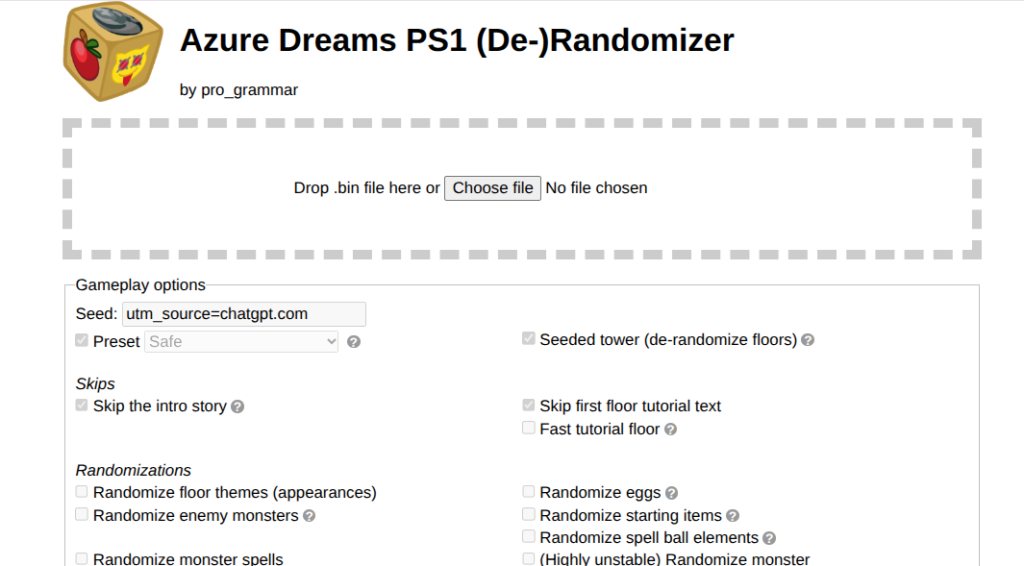
Someone in the audience was listening….pro_grammar. He privately messaged SandKnight and offered to fix it and that was the beginning of both pro_grammar’s involvement with the community and what would eventually become the Azure Dreams De-Randomizer.
Its first purpose was simple: seeded runs. Suddenly two tournament competitors could face the same enemies, items and circumstances. Previously, players had simply accepted that one person might receive a much harsher tower than another.
Randomness was part of the game. Now they could compete against equal odds. “That was powerful,” SandKnight said. But pro_grammar’s work did not stop at tournament seeds.
The Second Tower
When I asked SandKnight what pro_grammar had uncovered that surprised him most, he did not hesitate…The second tower.
This was news to me! I have considered Azure Dreams my favourite game for most of my adult life and I had no idea that a second tower existed.
Through reverse-engineering, pro_grammar uncovered a second tower containing an apparently infinite number of floors, randomised monsters, an item-obfuscation mechanic and even different graphics on some floors. SandKnight remembers the discovery vividly. “It was mind-blowing.” Almost immediately, he attempted a speedrun of the newly revealed tower as a surprise for the community.
He describes it as one of the most exciting periods in the server’s history. The first appearance of that second tower was preserved on video, and it is still possible to watch that moment today.
Watch the first appearance of the Second Tower on YouTube
For somebody who believed he knew Azure Dreams, discovering this nearly three decades later was an unexpected reminder of exactly why I started this series. There are still things about this game I don’t know.
The People Keeping It Alive
SandKnight is quick to point out that the community’s survival has never been the work of one person. Several names repeatedly came up during our conversation.
Czaj, he says, has quietly done enormous amounts of work and effectively picked up parts of the technical work after pro_grammar became less active.
SepticTank5 is, at the time of our conversation, one of the strongest speedrunners in the community, holds the current World Record for an Any% run at 23m 02s and was instrumental in bringing Azure Dreams into the Archipelago multiworld project.
Alymra helped expose the game to a wider audience by running it during the Questing for Glory 8 marathon.
Wugga has consistently pushed the game competitively and spent a long period holding its world record.
“Obviously there are so many,” SandKnight said, “but we would be here for hours.” That may be one of the most important things he told me. I began this project wondering whether anyone else still cared about or even remembered Azure Dreams. Now I am being told there are too many significant community contributors to comfortably list.
Would SandKnight Want a Remake?
This is where his answers became particularly interesting. Because he honestly doesn’t want a remake. SandKnight is deeply sceptical about the idea of Konami remaking Azure Dreams. He describes the original as a “lightning in a bottle” game and worries that a large publisher may fail to understand what made it work. He is also concerned that renewed commercial attention around the IP could affect fan projects.
His position is not that a remake would somehow destroy the original. “If you don’t like the remake you can always just play the old one,” he said. But he believes a poor remake could damage enthusiasm around the franchise and potentially make some long-time fans less inclined to return.
If a remake absolutely had to happen, his preferred approach is conservative. Keep the mechanics, Keep the responsiveness.
Add modern quality-of-life features.
Add widescreen support.
Provide accessibility options.
Release the game officially on PC so players no longer have to rely on emulation.
And if Konami wanted to create new content? That would be fine too. His condition is simple:
“You can make more towers or towns, but leave those you made as is.”
Expansion rather than replacement.
Could Azure Dreams Succeed Today?
Again, SandKnight is more cautious than I am. In fact he holds the opposite view point to me. The popularity of roguelikes, monster-taming games and cosy games might seem to suggest Azure Dreams could find a much larger audience today but he is not convinced.
The game is difficult, It is obtuse, It explains relatively little and modern players have infinitely more choice.
He remembers an era when somebody might rent a single game for the weekend. If that game destroyed you on Saturday morning, you tried again. There was nothing else coming until the following weekend. By Sunday, you might be hooked.
Today? A player can buy a game digitally, get demolished in the opening hours, refund it and be playing something else before lunch.
There is also another problem. The term “roguelike” now covers a vast range of games. Many modern players who say they love roguelikes may have little interest in actually playing something close to the original Rogue. SandKnight considers Azure Dreams much closer to that older tradition.
The graphics, too, could be an obstacle. He still finds them charming. He also freely admits that they were rough even at the time.
Perhaps Azure Dreams could find a larger audience today.
Perhaps it would remain a game for a very particular type of player.
Someone willing to fail.
Someone willing to experiment.
Someone willing to die repeatedly until suddenly the systems begin to make sense. We have seen the massive success of the Dark Souls series afterall.
From Obsession to Family
I finished by asking SandKnight a simple question:
Nearly thirty years later, what does Azure Dreams mean to him now?
His answer was immediate. “It was my obsession. Now it has become my family.” He still logs into the Discord every day. Some conversations are about Azure Dreams. Others are simply about life. The people he originally met because they shared an interest in an obscure PlayStation game are now people he considers friends.
He created the server almost eight years ago because he wanted somewhere to discuss speedrun strategies. It became something far larger than that. And perhaps that explains why Azure Dreams is still here.
Games do not survive for thirty years because discs remain on shelves. They survive because people continue to care about them. SandKnight helped create one of the places where those people could find each other.
Nearly eight years later, they are still there, still climbing the tower.
About the Author