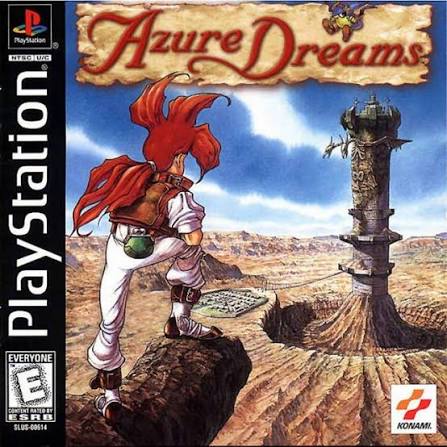
Azure Dreams at Full Speed: SepticTank on Speedrunning, RNG and Breaking Open the Tower
For most players, Azure Dreams is a slow-burn game. You enter the Monster Tower, climb a few floors, collect what you can, retreat to Monsbaiya, improve your town, raise your familiars and gradually become stronger. For SepticTank, the tower became something very different.
It became a race.
A game built around uncertainty, exploration and survival became an exercise in rapid decision-making, resource management and adapting to whatever the random number generator decided to throw at him. And eventually, that approach led him to world records.
From Rental Store to World Record Holder
SepticTank first encountered Azure Dreams through a local rental shop. Not Blockbuster. Just one of those smaller independent stores that once seemed to exist everywhere. He rented the game several times before eventually buying his own copy as an adult.
From the beginning, two things kept drawing him back: the monster mechanics and the randomness. Because the tower could unfold differently every time, the game never quite became predictable. Years later, that same randomness would become one of the reasons he began speedrunning it.
SepticTank originally returned to the game casually while streaming, following a revisit of Dark Cloud. Members of the Azure Dreams community discovered his stream and invited him into the Discord — affectionately known as the Kohmunnity.
There he began racing another player, Horza, while learning strategies involving familiars and mix magic. Eventually, something changed. Instead of entering the tower several times and gradually building towards the top, SepticTank found himself completing the entire tower in a single visit. Once he realised that was possible, speedrunning followed naturally.
“It was so fun to play that way.”
Speedrunning Azure Dreams Isn’t About Fast Fingers
The obvious assumption with speedrunning is that success requires exceptional mechanical execution. Perfect button inputs. Frame-perfect tricks. Complex movement.
Azure Dreams is different.
According to SepticTank, one of the most important skills is simply thinking quickly.
The original game rarely forces the player to make strategic decisions under pressure. You can stop, examine your inventory and decide what to do. A speedrun clock removes that luxury.
Menus are instantaneous, which means runners need to know where items are positioned, remember where the cursor was left and instinctively navigate inventories without hesitation. A single moment of menu confusion can cost time. But execution itself is arguably the least important part. Game knowledge, resource management and adaptation are far more significant. A runner needs to understand not simply what every item does, but when using that item would be wasteful.
SepticTank repeatedly comes back to resource management because, in his experience, almost no successful run survives without squeezing maximum value from everything the tower provides. Pasted text
The Moment You Stop Relying on Kewne
One of the biggest differences between casual play and high-level speedrunning is the relationship with familiars. Many players rely heavily on Kewne and that makes perfect sense. Familiars provide protection, damage and flexibility throughout the tower.
But SepticTank argues that anyone chasing a sub-40-minute Any% run eventually has to abandon that safety net. Remove the familiar, and suddenly the game asks a very different question:
Do you actually understand the tower well enough to survive alone?
Without a familiar protecting Koh and preserving resources, item management becomes considerably more important. That change also exposes just how many mechanics casual players can completely overlook.
Throw Monsters at Monsters
One of SepticTank’s favourite examples is the humble lift-and-throw mechanic. Pick up a monster and throw it into another monster, and the target can be turned around. Take a step after lifting before throwing, and you can manipulate which direction the monster walks.
Then there are the game’s aggro systems.
A monster that loses aggro inside a room may choose a new exit. This allows experienced players to deliberately walk into a room, attract attention, leave again and manipulate the monster into heading somewhere else. What looks like a straightforward dungeon crawler starts revealing a surprisingly deep system of enemy behaviour.
For casual players, these tricks may seem unnecessary. For someone struggling to survive long enough to heal between encounters, they can completely change the game.
Planning for a Game That Refuses to Cooperate
How much can you actually plan a speedrun of a game built around randomised tower layouts? As it turns out…not much.
SepticTank describes speedrunning Azure Dreams as “basically all adaptation.”
There are plans, particularly around resource management. Certain balls are valuable against particular monsters. Others become inefficient depending on elemental match-ups. A runner constantly weighs which resource solves the current problem while preserving enough options for whatever comes next.
But then the tower changes the question. Perhaps you simply never encounter the monster you were saving an item for. Perhaps the floors allow you to skip that entire problem. At that point, the plan becomes irrelevant and the runner adapts again. And that randomness is not a flaw in the speedrun.
For SepticTank, it is precisely why the run remains enjoyable.

Grinding Until the Impossible Run Appears
At the time of our conversation, SepticTank holds world records in Any%, Curry% and Pulunpa%.
Yet he is very careful about what those records actually mean. He does not believe having the fastest time necessarily makes him a better player than runners such as Wugga or Baldwin. At the highest level, everyone is already playing incredibly well.
Eventually, record chasing becomes a combination of preparation and patience. Players grind until their execution and decision-making are operating at their peak. Then they keep grinding. Hundreds of hours. Potentially thousands. Eventually, the tower generates a run where the randomness finally lines up with the player’s ability.
That is when records happen.
For readers unfamiliar with speedrunning terminology, Any% is the standard type of category where the aim is simply to reach the required ending as quickly as possible, using whatever methods that category’s rules permit.
Curry% and Pulunpa%, however, deserve slightly more explanation. Because apparently the Kohmunnity cannot be trusted to leave a perfectly respectable speedrunning leaderboard alone.
Lord Badger’s Note: Yes, Curry% is an actual thing
With the help of the Kohmunnity, I discovered that Curry% is an actual speedrun category born entirely from a meme. HexTree explained that Curry% is a speedrun whose entire objective is to reach the point in Cherrl Child’s storyline where Koh can select the dialogue option “Curry.”
Shortly before Cherrl becomes your girlfriend, she tells Koh that he didn’t need to hide the fact that he cured her illness. Your response options are:
“Sorry”
“Sorry”
“Curry”
The line is apparently intended as a reference to a Japanese saying — something along the lines of “Rice Rice Curry” — but in the English translation it comes across as wonderfully random. So naturally, the community turned it into a meme.
To complete Curry%, the runner needs to collect 4,000 gold to build the hospital and retrieve the Healing Herb from Floor 29.
HexTree told me that the community originally theory-crafted the route as a joke. He then went away and actually speedran it the following day. At which point the Kohmunnity did the only sensible thing possible:
They made it an actual speedrun category.
HexTree describes it as “Bookless-lite”, because it focuses on one of the key objectives required in the much longer Bookless category.
So yes: SepticTank genuinely holds a world record in a speedrun category created because somebody thought it would be funny to see how quickly Koh could say “Curry.”
I bloody love this community.
And then I asked what Pulunpa% meant….That somehow made things even better.
Lord Badger’s Note: Reconstructing Pulunpa% lore
Curry% is not the only competitive category that started life as the Kohmunnity messing around.
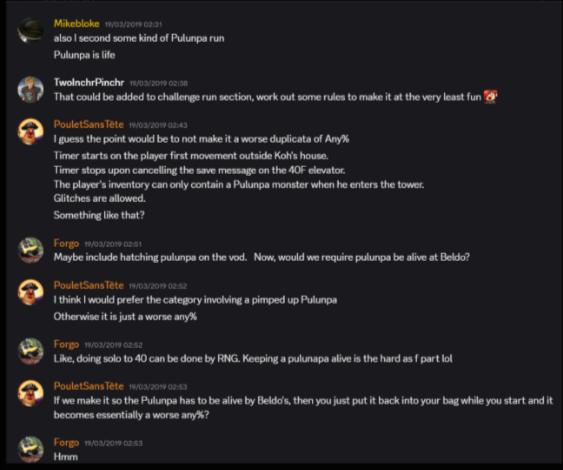
Umaro explained the rule to me: hatch a Pulunpa egg on Floor 1, then keep that Pulunpa alive all the way to Floor 40 without ever putting it in the bag.
What followed was one of my favourite moments while researching this series. HexTree initially remembered Pulunpa% as one of several challenge ideas preserved on an old community spreadsheet. Then, mid-conversation, he discovered the spreadsheet still existed and shared it with me!
A genuine little relic from the community’s past.
Except Pulunpa% wasn’t on it. For a few minutes, the Kohmunnity started reconstructing its own history in real time. Had the Pulunpa page been deleted after the category moved to Speedrun.com? Had it started somewhere else entirely?
Umaro then offered his own memory: he thought he had repeatedly proposed the challenge in Wugga’s stream chat until Wugga finally ran it to get him to shut up.
I asked whether that was factually accurate enough to print. And after checking with Wugga, we have an answer.
Yes. It was.
Pulunpa% exists because Umaro effectively bullied Wugga into running it.
Wugga completed the challenge, the idea stuck, and what began as someone repeatedly pestering a streamer eventually became a recognised competitive category. Which means SepticTank now holds a world record in a speedrun category born because Umaro simply refused to let an idea go. Although since speaking to the Kohmmunity it seems more information on the origin of the Pulunpa% may have come to light.
I am beginning to suspect that giving the Kohmunnity spreadsheets and streaming capabilities was a mistake.
There is something wonderfully revealing about that little exchange. This is what a living community looks like after nearly three decades. Not everything survives as a perfectly documented timeline. Old spreadsheets resurface. People remember events slightly differently. Someone digs through old records. Another person goes and asks the bloke who was actually there.
The community has existed for long enough that it now has forgotten lore and relics of its own.
Azure Dreams doesn’t just have history anymore. The Kohmunnity does too.
The Only Predictable Minute
In fact, SepticTank argues there is only one part of an Any% run that can be truly optimised.
The beginning. The tutorial floor and what he refers to as the glitch entry are consistent enough that runners can create a reliable solution. After that?
Welcome to the tower. Everything becomes a negotiation with RNG.
The runner can improve their decision-making, refine strategies and reduce wasted movement, but they cannot control what the tower generates.
My nterview with Septic Tank doesn’t go into the mechanics of the glitch entry, but its significance is clear: it forms part of that tiny opening section runners can reliably optimise before the randomness takes over.
That creates a fascinating difference between the theoretical best time and anything realistically achievable.
The Any% record SepticTank cited during our interview was 23:02.
A TAS can complete the game in roughly ten minutes.
(TAS stands for Tool-Assisted Speedrun. Rather than representing an ordinary real-time human attempt, a TAS uses emulator tools to construct an extremely optimised run and explore what may theoretically be possible.)
What makes the Azure Dreams example particularly fascinating is SepticTank’s point that its advantage does not come from performing wildly impossible actions. Knowledge is the real superpower. The TAS knows where the traps are.
In theory, there is a seed somewhere where the elevator could appear only a step or two away on every floor. A human could technically play that seed. Finding it naturally is another matter entirely.
For runners who would still like to have lives outside Azure Dreams, SepticTank estimates that perhaps another minute or two represents a more realistic amount of improvement remaining.
Why Curry% Means More
Despite holding several records, the one SepticTank is most proud of is Curry%. And now that we know how Curry% came into existence, that answer somehow becomes even better.
The reason is partly mechanical and partly personal. As a child, SepticTank became particularly attached to Cherrl’s story. Curry% revolves around that storyline, giving the category an emotional connection beyond simply reaching an endpoint as quickly as possible.
It also contains more predetermined town movement and dialogue than some other categories, meaning mechanical mistakes can cost more time. SepticTank describes himself as better at thinking than executing — one reason Azure Dreams fits him so well.
Holding the Curry% record therefore means something extra.
Especially because beating players such as Wugga required him to avoid exactly the sort of mechanical mistakes he worries about making.
Manoevas Are Apparently Almost Blind
Speedrunning communities often discover things about games that developers probably never expected anyone to notice. Azure Dreams is no exception.
One discovery attributed to Baldwin concerns Manoevas. Outside rooms, their vision is astonishingly poor. Unless Koh ends his turn directly beside one, a Manoeva in a corridor may fail to notice him. At L-shaped corners, it can sometimes be possible to simply walk past without triggering aggro. That is extremely useful because Manoevas appear repeatedly throughout the tower. An enemy that once seemed like an unavoidable obstacle suddenly becomes something an experienced player can casually sidestep.
This is perhaps one of the most interesting things about watching a game evolve through speedrunning. The software has not changed.The players have.
From “Floor 20 Might Be Possible” to Beating the Game Without a Familiar
The competitive community’s understanding of Azure Dreams has changed dramatically.
Before SepticTank joined, players were apparently discussing whether reaching Floor 20 during the first tower entry might even be possible.
Eventually somebody did it.
Then players realised the entire tower could be beaten in one entry.
Then it became repeatable.
Then another assumption fell.
The familiar that had seemed essential to surviving the climb was removed entirely.
And the runs became faster.
That progression perfectly demonstrates how speedrunning communities dismantle old assumptions one after another.
Every time the community believes it has found the limit, someone asks whether the supposedly essential rule can be broken.
Making Azure Dreams Multiplayer — Sort Of
SepticTank’s contribution to Azure Dreams goes beyond speedrunning. He also helped bring the game into Archipelago. For anyone unfamiliar with it, Archipelago is a multi-game randomiser system allowing players in different games to influence one another’s progression.
SepticTank had previously played Archipelago with A Link to the Past and even experimented with an original Resident Evil 3 project. That gave him some understanding of how the framework worked.
It did not make programming MIPS assembly pleasant.
“MIPs assembly is NOT fun to code,” he says.
Ultimately, the project happened because enough people were interested in seeing Azure Dreams supported — and, as SepticTank readily admits, because modern AI tools helped make the programming work possible.
The result turns Azure Dreams into something loosely resembling multiplayer. SepticTank created progression gates where tower elevators become locked at certain intervals and require keycards. But the player who needs that keycard may not be the person who finds it. A friend connected through Archipelago might have to find your keycard instead.
He also implemented the ability to send items between separate Azure Dreams games through the Archipelago framework. Suddenly a fundamentally single-player PlayStation RPG can become part of a shared cooperative experience.
Fighting Against Two Megabytes of RAM
The biggest technical obstacle was exactly where you would expect.
The tower.
The PlayStation’s memory limitations leave extremely little space for adding new functionality there. The town provides more freedom. Inside the tower, much of the available RAM is already occupied by combat systems and other essential mechanics.
“If the game ever escapes its emulation confines,” SepticTank says, “so much can be opened up.”
For now, though, developers working on these community projects have to contend with the reality of a game designed around roughly two megabytes of RAM.
Community Projects Keep Monsbaiya Moving
Archipelago remains a relatively small project, but randomisers, challenge runs and similar community creations regularly bring activity back into the Kohmunnity. For SepticTank, though, they are not necessarily what keeps Azure Dreams alive. He believes the game is simply strong enough to keep bringing people back on its own merits.
The tower remains the part that has aged best. The deeper players dig into its mechanics, the more they realise just how much control the player actually has over situations that initially appear entirely random. Unless, as SepticTank puts it, you simply get bad trap luck.
What Has Aged Worst?
The story. No hesitation there.
SepticTank jokes that the opening sequence feels like 90% of the game’s narrative. Thankfully, for speedrunners, the timer doesn’t start until after the opening story. Also the speedrunner community is emulator friendly so save states that skip the intro are allowed and are in fact the standard for the community. But SepticTank point still stands. once the adventure begins, surprisingly little core story remains.
There are only a couple of major in-game scenes and an FMV before the central story reaches its conclusion. Compared with the depth of the tower systems, the narrative can feel extremely thin.
Don’t Turn Azure Dreams Into Something Else
When discussing a potential remake, SepticTank draws a very firm distinction between a remake and a reimagining.
He would happily see additional monsters. He would welcome expanded character stories. The central narrative could be developed considerably further. But the fundamental gameplay should remain intact.
Changing the combat into a real-time system, for example, would cross the line. At that point, in his view, it would cease to be the same game.
Modernise the visual fidelity. Keep the perspective. Keep the mechanics. Keep the tower. Keep the feel.
That philosophy extends to the difficulty and randomness.
SepticTank would rather see the original identity preserved than have core systems simplified purely in an attempt to attract a broader audience. He acknowledges that this immediately creates a difficult business question for Konami. Perhaps a completely faithful remake would not appeal to enough new players. But if making it commercially viable required removing what makes Azure Dreams distinctive, SepticTank would rather it remained untouched.
Almost Thirty Years Later
After decades of playing, speedrunning, analysing and modifying the game, I asked SepticTank the same question I have been asking throughout this series.
What does Azure Dreams mean to him now?
He struggled to answer it. There is nostalgia, obviously. There have been countless hours of entertainment. There are records, races and discoveries. But perhaps the most important legacy has nothing to do with the tower. It is the people.
Azure Dreams introduced SepticTank to friends throughout his adult life.
“Some of the greatest people I know sit in the Kohmunnity.”
And maybe that tells us something important about why this obscure PlayStation game refuses to disappear.
WereWorld showed us a game people still want to explore.
SandKnight showed us a community built around keeping it alive.
SepticTank shows us something else entirely:
A game whose systems are still being learned, manipulated, raced and rewritten almost thirty years later. The Monster Tower may only contain forty floors. But apparently we still haven’t reached the bottom of Azure Dreams.
About the Author